A physical installation that showcases the 352 electromagnetic captures required by NASA to produce the 1995 Deep Space image.
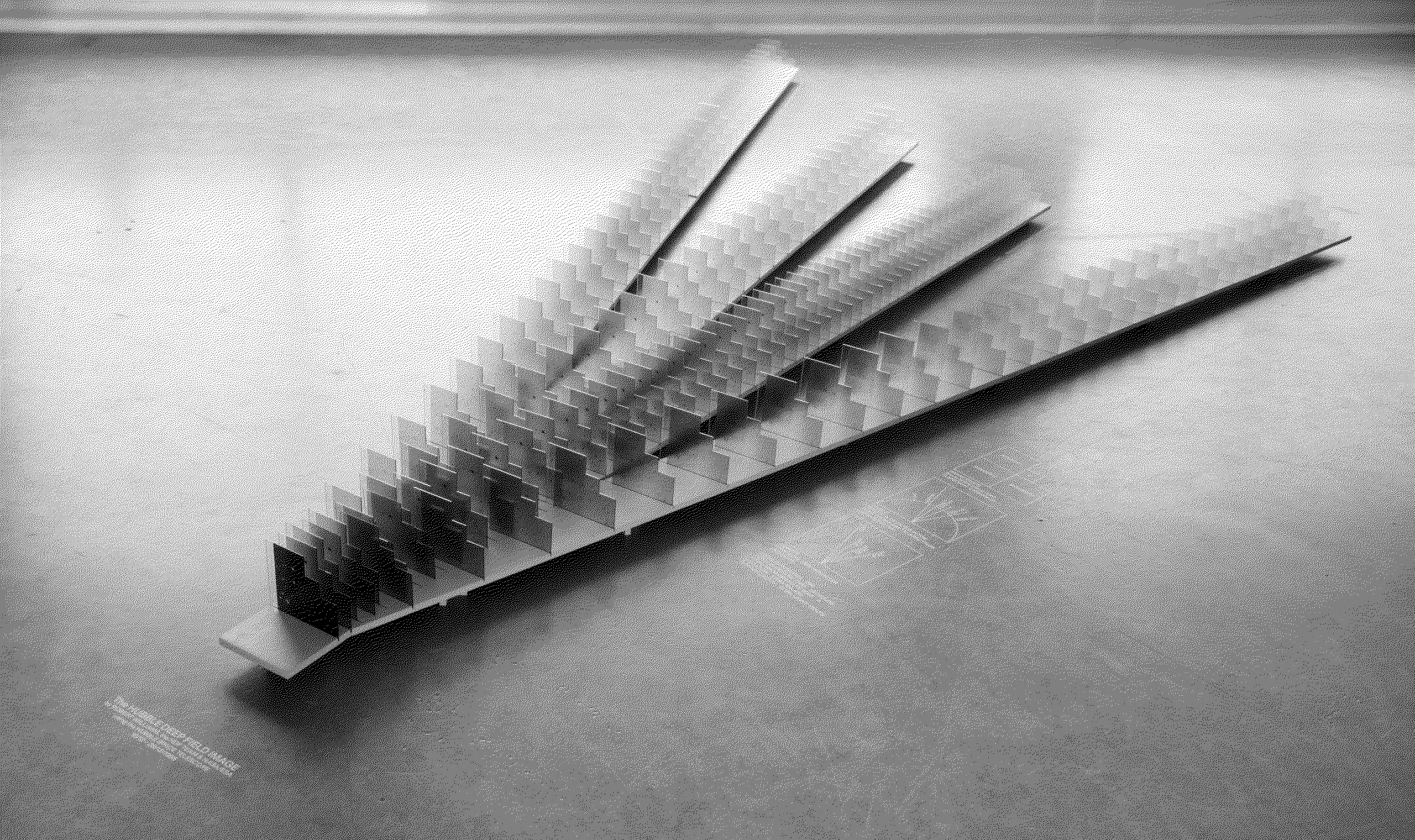
Image Lea Wurthmann (reproduced with permission)
“Staring at Empty Spaces”, by designer Lea Wurthmann is an exceptional kind of datartefact: it exposes, through a physical object, the composition of a representation (e.g. an image), while also exposing the method (from electromagnetic sensors to computing process) used to produce that image.
As such, “Staring at Empty Spaces” definitely fits within the category of “objects that functions as a document”, and even in this case, as a meta-document: one that illuminates the history of sciences and techniques about how another “document” (the Hubble Deep Field Image) was produced.
The physical form chosen by Lea Wurthmann exposes the complexity of the process that led to the final image by revealing, one by one, the 342 long electromagnetic exposures that were converted, processed and assembled to produce the final representation, one that makes that part of the universe visible to the human eye. In this sense, the work operates as a reverse autographic system: it returns to the level of the “initial traces” from which a composite image was algorithmically reconstructed.
Further reading